From the movie script The Handywoman of the Hidden Valley* by Paul Christopher Walton:
Can you repair a damaged person as you might a tumbledown house?
When a young schoolteacher grieving after a terrible accident is evacuated to the countryside at the start of World War II, she finds healing in the company of a charismatic colleague who’s determined to rebuild an isolated broken-down farmhouse and her friend’s broken spirit.
But as the war ends, this safe haven in the mountains cannot hold against the strong desires and longings one of them has for the world left behind. The Handy Woman of the Hidden Valley is a tender, quietly radical love story about resilience, reinvention and the imperfect art of repair
EXT.BLAEN Y CWM: THE GARDEN EVENING
A party to celebrate VE day in the laundry garden. A trestle table with party food including egg and sausage pie, wartime loaf and rabbit fricassee. Pride of place goes to a roasted pork joint.
There are bottles of beer from the George. Union flags are draped over the farmhouse bedroom windows and over the Coventry Eagle.
Mat is toasting her London musical friends; Anne stands with Kath and Iolo, Richard Price, Willie and his sheep dogs, Mrs Price and their helpful neighbours from Canol.
In the garn, the sheep graze contentedly.
Later Mat plays her Dulcitone, Arnauld the ‘cello, Blanche and Toni have violins. After a rousing Rule Britannia, Richard Price, Willie and the Canol neighbours sing Land of My Fathers in their native tongue. There are tears and laughter.
Mat has a wind up gramophone and starts playing dance music.
TONI:
Do you know the Lindy Hop?
Toni grabs Willie who at first is a little flustered but finds dancing with Toni surprisingly good fun.
Arnauld, Mat, Blanche, Kath and Iolo join the dancing.
Toni, Blanche and Mat take it in turns to change the records including Run, Rabbit, Run; Stompin at the Savoy; It’s a Hap-Hap-Happy Day. The Okie Cokie
The long day begins to fade. A heron passes over the house on its way to the estuary. A crimson flush lights the sky behind Diphwys. The north face of Cadair turns brilliant pink for just a few moments.
BLANCHE:
My turn. How about some Glenn Miller?
Glenn Miller’s Moonlight Serenade plays on the gramophone.
Kath and Iolo, Toni and Blanche and Arnauld and Mat are dancing slowly cheek to cheek.
Anne looks on watching Mat intently.
She sees Mat and Arnauld dancing intimately almost as if there was no one else there. They stop and as Arnauld lingers in the moment, Mat separates and almost stumbles towards where Anne is standing looking on
MAT:
I’m so very happy, Anne, I never want this night to end.
ANNE:
Nothing lasts for ever, Mat.
Anne turns and walks away. Anne noisily collects plates and marches into the house leaving Mat with her friends.
At first Mat seems conflicted but after a moment she resumes dancing with her friends.
The Handywoman of the Hidden Valley is inspired by Four Fields, Five Gates, the memoir by by Anne Loris Hill
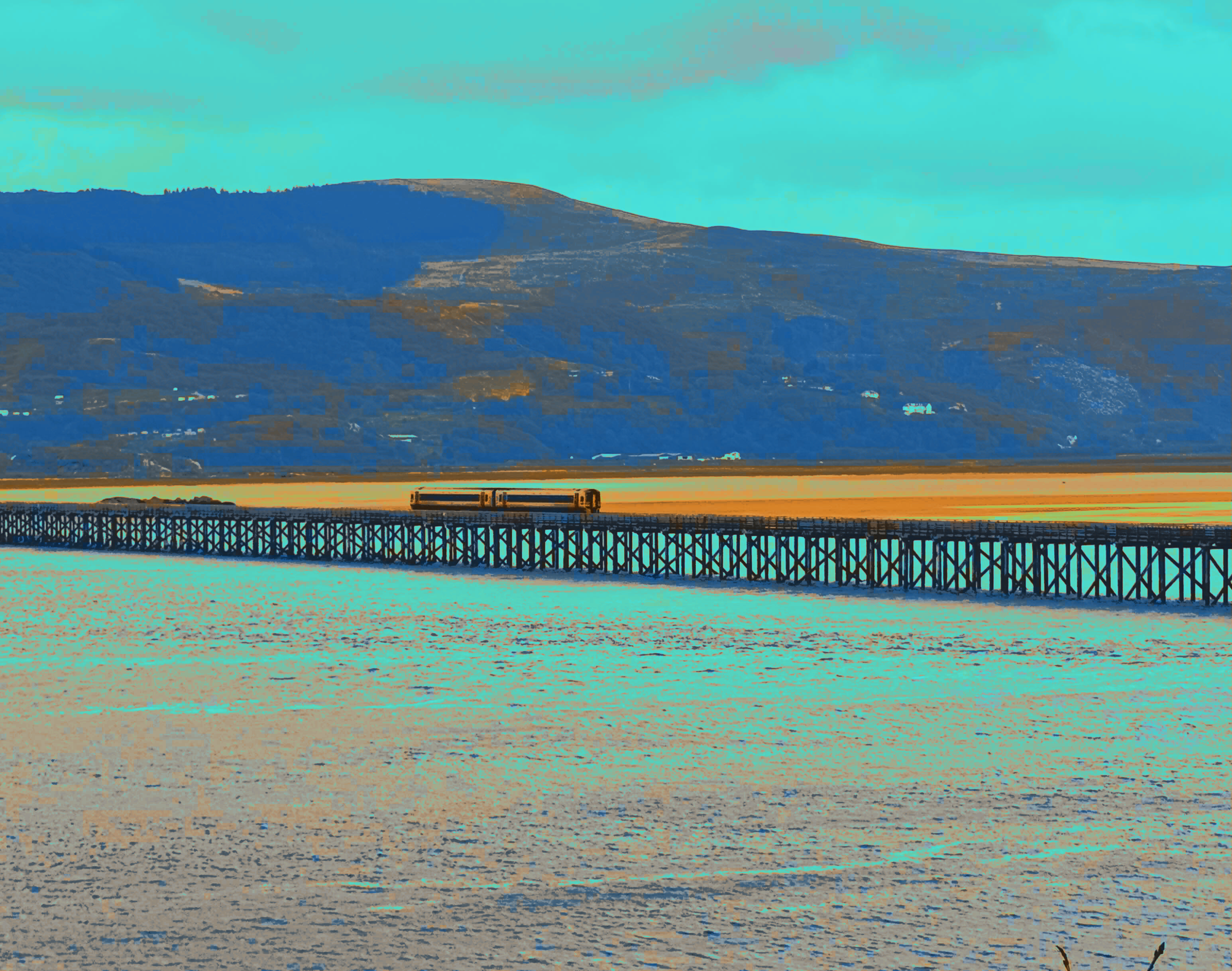
There’s a wonderful magic that transforms and heals and it takes place in an old fisherman’s cottage on the Cambrian cliffs near that famous bridge in Barmouth.
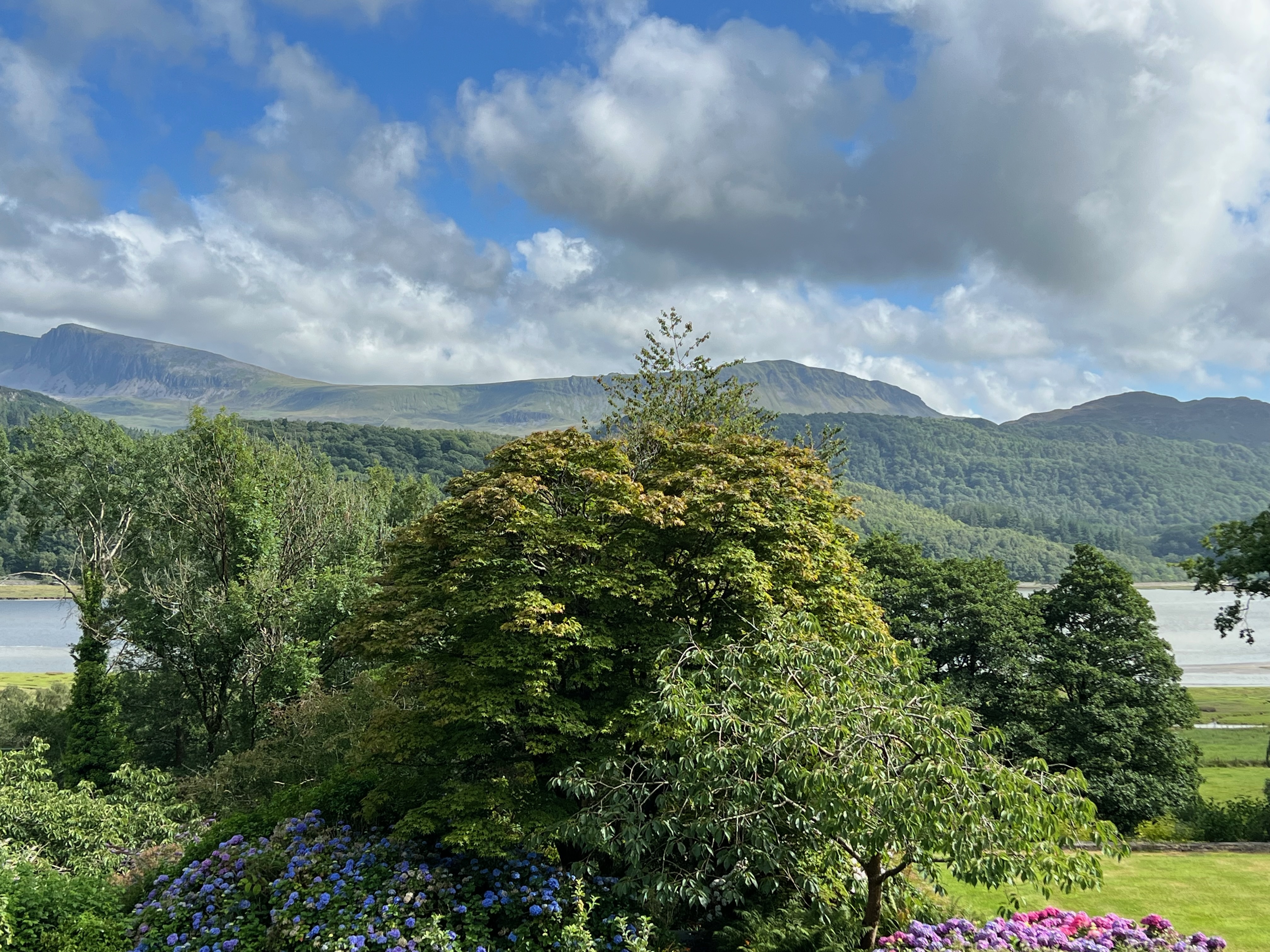
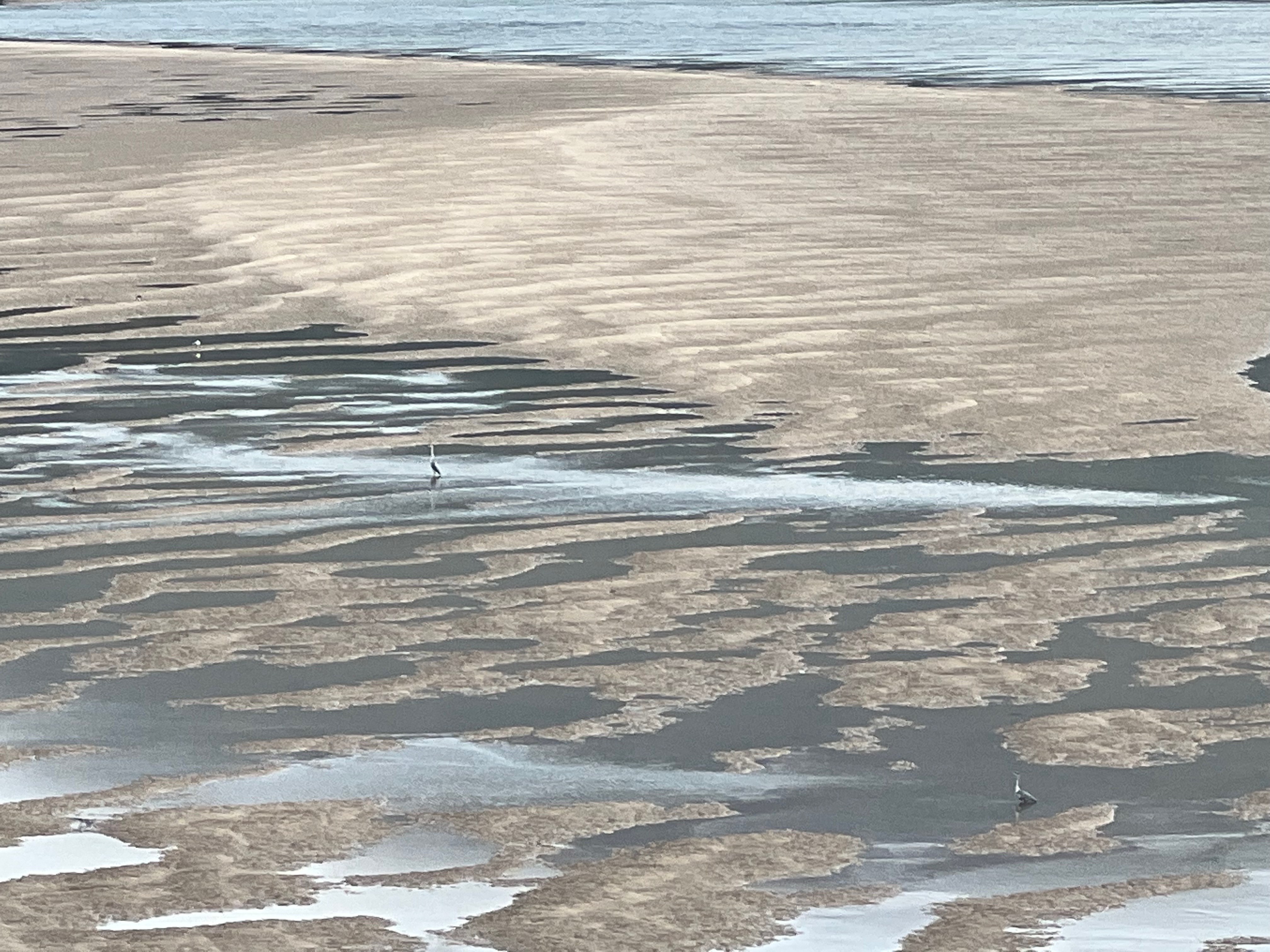
It comes from watching the ever changing, ever absorbing landscape of Cader’s Ordovician rocks; and the Mawddach’s sand art that tantalizes at every ebb and flow.
Or from the wind rushing through the tops of oaks, or when an Argentine moon climbs above Tyrau Mawr; or when you hear the chit chat of oyster catchers on night patrol.
It comes from the dotted quavered rhythms of rolling stock on rusted metal or the polite signal of acknowledgement given to hands that wave. It comes from the sound of steps on floorboards and the contented well-stuffed laughter of old friends on the deck and the Clock House chime that says time for one more glass.
‘Thus did it come to pass that on the 23rd November 1963, the first QMGS Expeditionary Force left Walsall for Merioneth, carrying with it all of the impedimenta that Headmaster Sam Darby and Phil Bull, the newly appointed first Warden of Farchynys, had been able to blag. On arriving at The Coach House, the party had a somewhat comedic moment when the key to the front door could not be immediately identified from the collection it had just acquired….’
From Marians on the Mawddach by Paul Christopher Walton
Roger Redfern is one of my favourite writers about the Mawddach estuary and the mountains he knew so well – both as the chronicler of his family’s life on a dairy farm in Cutiau, and as one of The Guardian’s leading countryside correspondents.
This poem is taken from Verses from my Country and is the equivalent of a big, steaming mug of silky hot chocolate on a chilly Autumn afternoon.
WHERE THE GORSE IS GOLD AGAIN
A slant of winter sunlight through the naked trunks
And on the slopes to either side
The russet bracken flaming.
The little trees are empty, still alive in sleep.
My shadow, long and pale, climbs up the slope of lane
Ahead, and on the brow it levels out.
Behind, the sea silent with distance
Creams on the winter shore,
Lit by a mellow sun.
In front, two men are walking
With a dog before me in the hillside glow.
No breeze rustles dead leaves
Not a sound but silence
Over all with her sparkling cloak
Says, “This is my domain, an ancient natural law.”
And up the hillside lane I go.
Where the sweep of Llawllech drops down
To the Mawddach glistening below,
And washed sands and pebbles sing
With the tide; there on the slopes
Where ffridd melts into higher brown
And ruggedness, the song of the curlew
Echoes in the sun that suggests coming spring.
Lone white and purple clusters
Bob above the breeze-washed grass.
Gorse is gold again and swinging gates are open wide.
The sky, like Pacific solitude, is ranged
W ith islands, white and mounta inous,
Floating high. Before the sun pales more the skylark’s
Song climbs to the unatt i inable blue.
At Ffridd Bant I look along
That lane that leads by bullrush bed
But not today to tread that way.
Instead up the hill between high banks
Past Llwyn-gloddaeth, empty as winter branches,
Onto the opening of the way, the levelling of the land.
The whole, wide world is opened up.
From Diphwys’s moulded top and far sheepwalks
To cringing grass-blades at my feet –
A splendid harmony, a charitable harmony!
Now through the gate and down the lane,
On the way a wave from Llwyn-onn’s doorway.
Blue with paint; and Home again.
Through the gateway with the swinging gate
That squeaks and crashes to.
Down and down with walls of hazel and thorn
And whispering waters as I go
On the descending way.
I tread in Grace’s steps,
Long now silent since she went along the road
To live the evening days
In the hovel at Bontddu.
The fallen roof, the cowshed
And the chimney stacks
Stand, girt with shrub and leaf.
In the shade the everlasting waters run and splash,
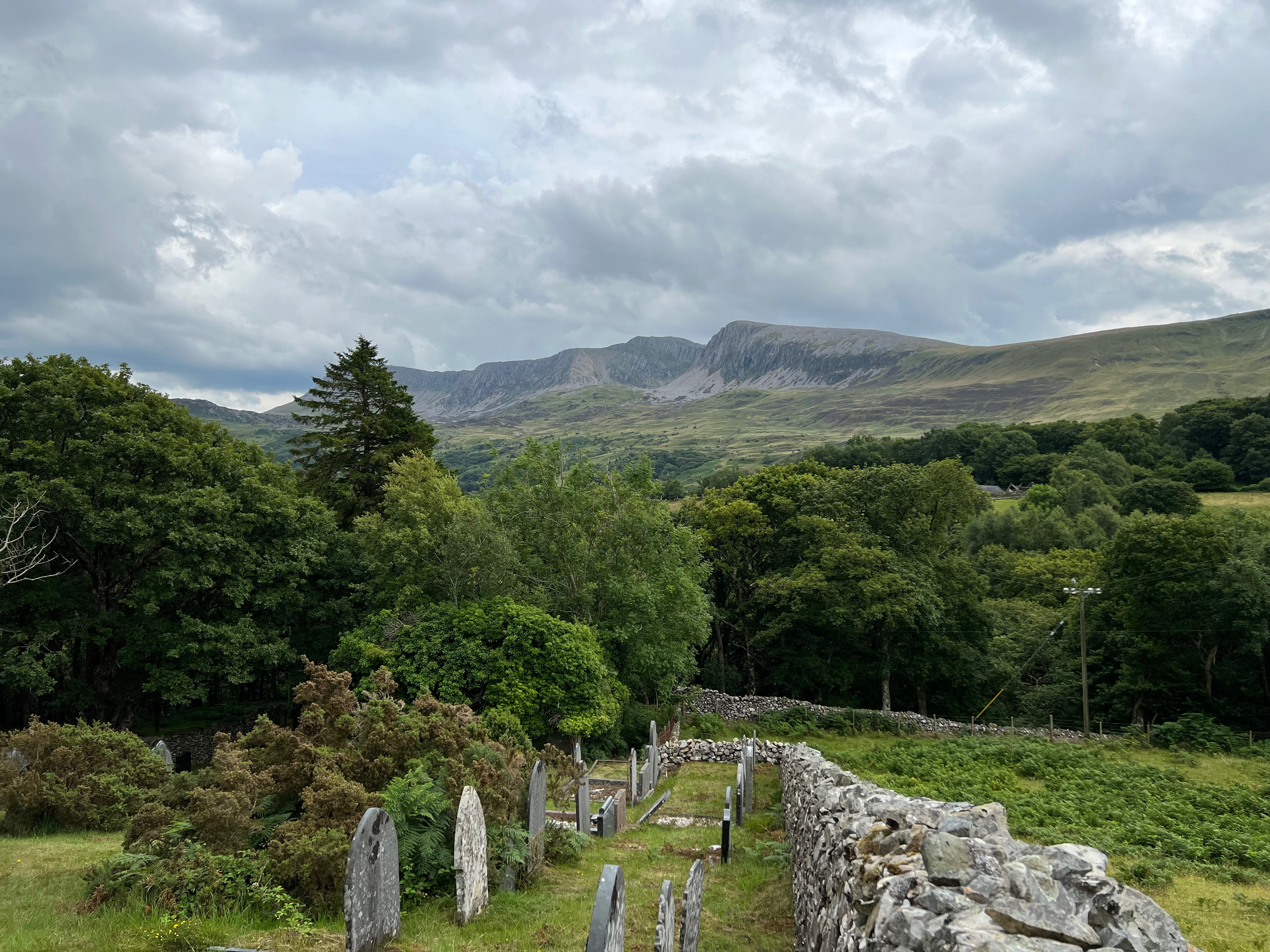
One of my most favourite places on the Mawddach is the ruined Methodist chapel and its cemetery in the foothills of Cader Idris. A place of silence and calm, it is also a place I associate with Geoffrey Paxton, quondam Head of Drama at Queen Mary’s who did so much to inspire a generation of actors and writers.
Following a successful expedition to Iceland in 1982, two of my fellow tour members noticed me cycling to work. Not long afterwards, late in Autumn term, they with another student collared me in a school corridor and asked if I would lead a cycling weekend to Farchynys. Caught unawares, I could only think of the problems that such a weekend would create, not least attempting to transport 15 bicycles up to Farchynys. I didn’t say no to the small delegation, but I didn’t say yes. However, a seed had been sown, and I went away and thought about the idea. I could cater for the boys, and a fellow member of staff would accompany me to help. I planned a route: one that was not too long and not too short, covering a variety of terrains, and which, most importantly, would be a challenge.
It was the transport of the bicycles that was the problem. Then after two weeks, Geoff Hall, one of the instigators, stated that his dad had access to a van that could transport the bikes to Farchynys. I rang his dad and then talked it over with the Headmaster and Warden of Farchynys. No one gave a negative response. So I launched the weekend with the usual School Assembly announcement but limited it to 4th-year boys and above. That decision was crucial as the route proved to be all of the challenge we intended. Fourteen eager boys came to the meeting, so the first Great Farchynys Ride was launched.
A date was set for January 1983; we crossed our fingers for good weather. Under today’s rulings and risk assessments, we’d never have made it to the start line. I remember very few boys wore any semblance of a helmet. They were provided with a rudimentary sketch map of the route; there were no checkpoints or fuelling points; they were each given a Mars bar and told to take a bottle of water. I insisted that their bikes be roadworthy and have lights that worked. They all complied. That may seem negligent by today’s standards of safeguarding and H&S, but in 1982, none of this had yet become a restricting necessity. It made the event all the more exciting as the boys would be responsible for their own well-being, and at the end of the weekend, they were absolutely exhilarated. They talked of the enjoyment, the sense of adventure, and above all, the satisfaction of completing something most had never attempted or completed successfully before.
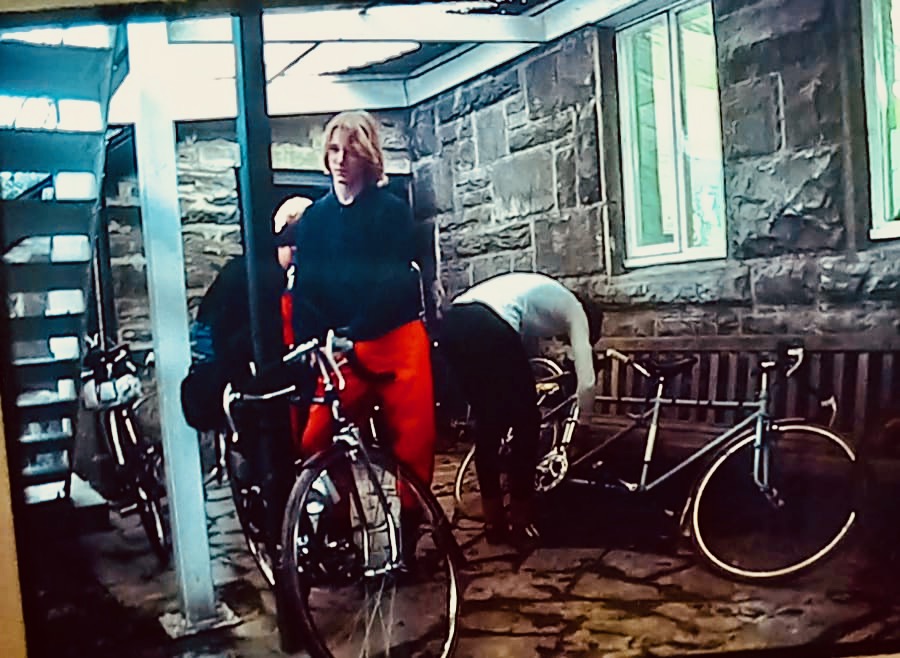
Bike check on the evening prior to the ride. Yossi Brain testing his saddle height
The evening before the Ride, the boys checked their brakes, tyre pressures, talked gear ratios and possible times for the 43-mile distance. Some boys had never undertaken such a ride before, and I think that innocence may have helped them. The experienced cyclists were relishing the challenge to test themselves. I mentioned some of the parts of the route which might challenge them, but I couldn’t give them first-hand experience of all of the ascents and descents as I’d only driven the route in a car or the school minibus on previous non-cycling trips. My eyes were well and truly opened after completing the Ride myself that weekend. Future rides over the same course would be better explained and the strenuous parts described. On the first trip, I was grateful to Stuart Holtam, who drove the minibus around the course acting as Safety Vehicle and also to Mr Hall (in later years Mr Joe Miles) for following the last bicycle and rider.
Startline at Farchynys January 1983
We set off on that Saturday morning in January in bright, winter sunshine, thankful that it was calm, but it was cold. We set off together, but it didn’t take long before we were strung out along the road that parallels the Mawddach on our way down to Barmouth. It was here that the sketch map didn’t prove adequate for some. The leaders flashed past the Las Vegas amusements instead of turning right to cross the railway line into Barmouth town centre. this preventing them from picking up the coast road northwards to Harlech. They ploughed on ‘til they reached the end of the promenade. Years later, whilst staying at the Hendre Mynach campsite, I discovered the route they found to cross the railway and gain access back to the main road. It is a very steep, narrow path. No wonder I saw they were pushing their bikes. As I went past, I remarked rather cruelly, “The shortcut didn’t work, then?” But they soon overtook me, and I never saw them again until the finish.
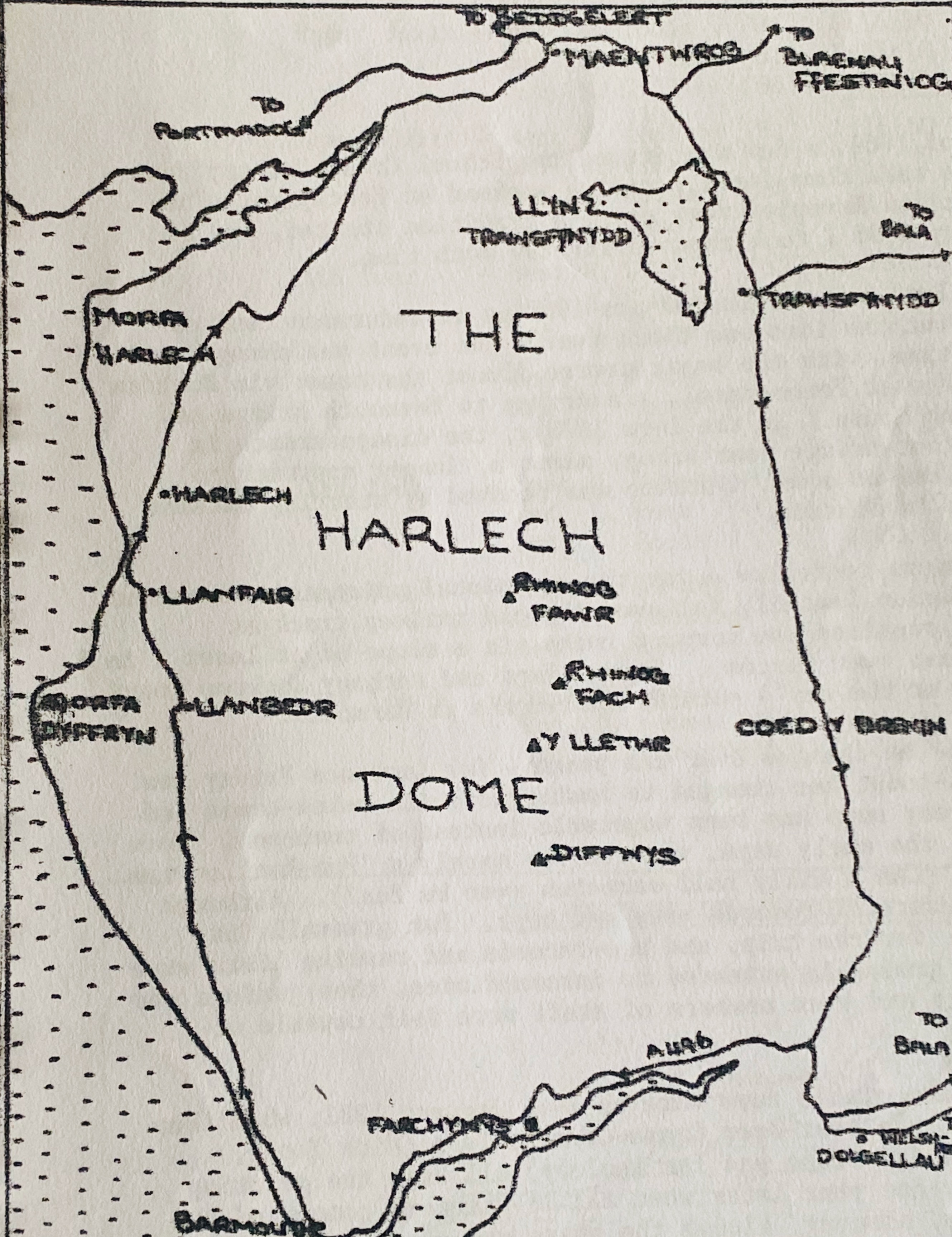
The views north along the coast road were quite stunning, and with a following wind, it was enjoyable. Much of the route is gently undulating from sea level to the lower parts of the raised beach section. This all changes at Llanfair. The Llanbedr Slate Mine is located on the right, and you have an easy view of it as there is a pretty steep hill to pedal up. Most boys didn’t have too much trouble; the heavier riders…. This ascent, of course, is balanced by an exhilarating descent back to sea level and past Royal St David’s Golf Club and over the railway tracks of the Harlech level crossing. The route didn’t go up into Harlech.
From there, if you’re cycling with someone, you can “draught” each other and motor along the flats of Morfa Harlech towards Llandecwyn.
After leaving Harlech Castle behind, Gary Turley taking a drink past Harlech
you can enjoy the stunning beauty of the steep-sided, drowned valley of the Afon Dwyryd in the Vale of Ffestiniog. Just past Maentwrog, you arrive at the fast road of the A487. I say fast because in a car it can be. On a bike, after 22 miles, you are faced with what one boy said was the nearest you come to an alpine-like climb. Over the next five miles, you climb steadily and take several sharp bends up to Gellilydan and finally Trawsfynydd. During one Ride, a faux castle, stabling and other sets were erected on the flattish land on the lakeshore of Llyn Trawsfynydd for the filming of ‘First Knight’, which starred Sean Connery and Richard Gere. If you watch the film, you may catch sight of the surrounding countryside but never the Nuclear Power Station which was then being decommissioned.
That year this was a minor distraction for the next section of almost dead straight road, which leads to the highest point on the course – 232m or 760ft. On some Rides, when the wind was blowing, this section could be brutal for the solitary cyclist. There was a gentle breeze on this first Ride, but it was much colder than at sea level. On this section, the hill climb begins to take its toll. Very little water is left and not much Mars Bar. After a number of gentle undulations, the descent back to sea level begins at Gelli-Goch and continues through and past Coed y Brenin. The road widening had not yet occurred in those early days, and a rather torturous road descent faced us. Luckily, everyone negotiated the tight bends bounded by dry stone walls without mishap. All the way down to Ganllwyd it is a fast and a lovely freewheel.
The painful memories of the hill climb were long behind and the air was quite deafening as it rushed past your ears. A short hill just before the turn for home at Llanelltyd nearly did for the author and some of those early riders. Trying to stand up on the pedals, both of my legs cramped up – straight. I nearly fell off and needed to take the rest of my water and attempted some deep breathing to ease my legs around the cranks and up the hill. I think you ride the last section back to Farchynys on adrenalin and determination. Some boys have been photographed pushing their bikes, resting by the side of the road or in a desperate sprint in these last four miles. Whichever it is, everyone is spent as they pass the finish line. Some wait there for their friends to arrive, having left them way back on the course. Early finishers, showered and changed, return to the gates to greet and cheer-in the later finishers.
In 1983, Richard Baynham was the first rider home in 2hrs 42 mins; last home was Robert Ball in 4hrs 12mins. In 1984 four riders failed to finish due to mechanicals. Baynham’s time was equalled in 1986 by Andrew Hipkiss. This, in turn, was beaten by a massive 15mins by Bryn Reynolds a year later. I have never hit a time less than 2hrs 35min in my 14 attempts. The Ride has taken place in windy conditions, heavy rain, bright warm sunshine and gorgeous autumnal colours. Boys have ridden road bikes, mountain bikes & tandems. Staff as well.
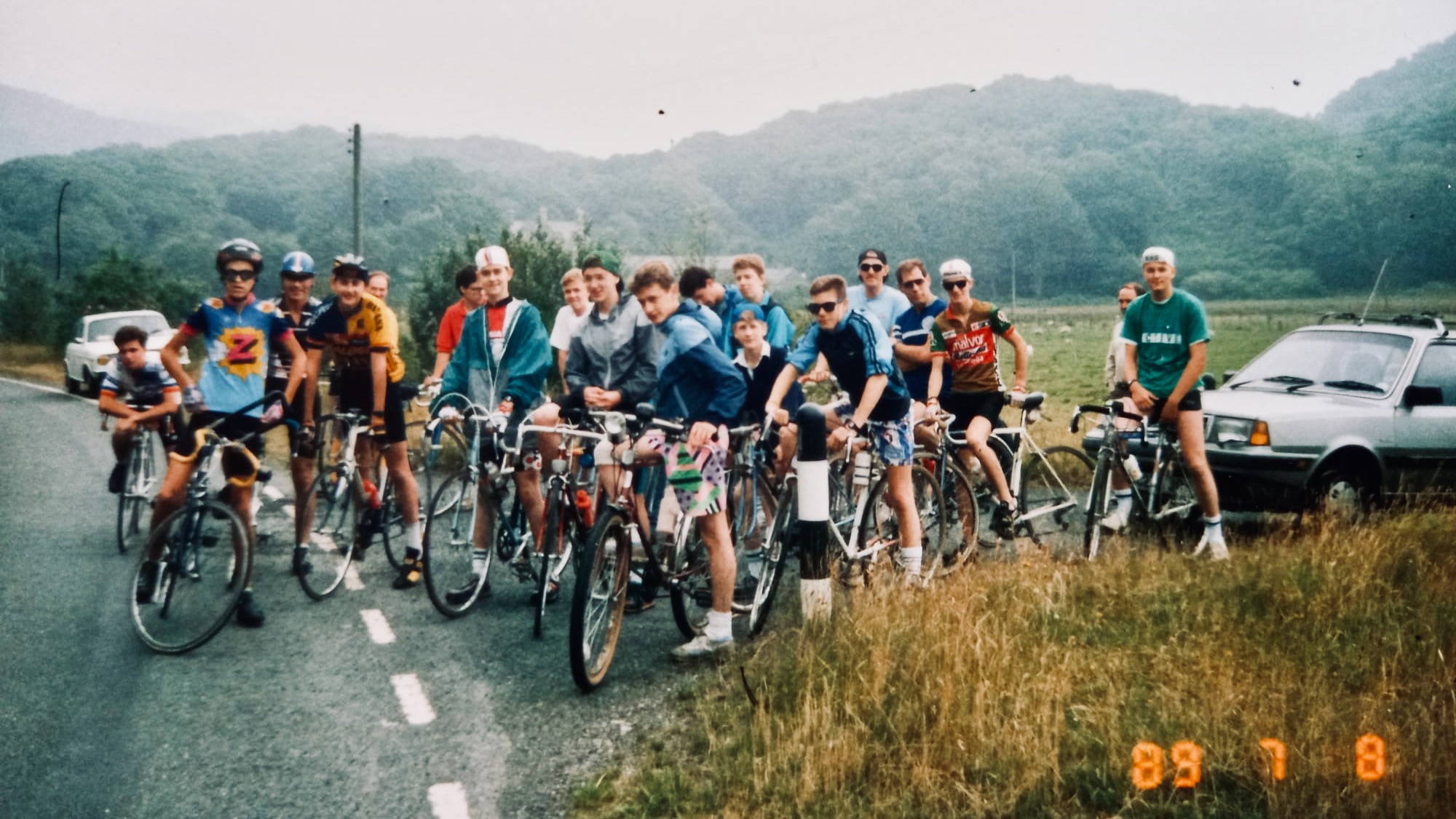
The riders muster at the start in 1989
Indeed, Peter Green holds the fastest time for a staff member, achieved on a lady’s road bike. Tim Swain as a young teacher, rode with a former 6th former – Matt Aston, on a tandem.
There have been several reunions. Geoff Hall, Chris Taylor, and I rode together on the 25th anniversary.
Three of the original riders
On the 25th anniversary, Daniel Gambles and his dad nursed me around; two other parents rode without paying attention to the map and instructions and turned right back into Harlech instead of left towards Llandecwyn.
Four staff members have ridden the Farchynys Ride and also completed the Farchynys Run – at separate times. Daniel Gambles recorded the fastest of all time: 2hrs 4mins in 1991. He was a phenomenal cyclist, encouraged by his cycling father, Phil. In the late 1980s, Mr Jack Aspinall, sometime Governor and a keen cyclist in his time, provided a magnificent trophy to be awarded on Speech Day for the first rider home. I wrote in the Farchynys compendium 1963-88 – “…it’s not about timings, it’s about the challenge that the Ride provides to everyone that attempts it.”
There are many memories of those weekends. Not all good, but I’ll bet that very few boys who rode on those weekends would think it was the worst day of their lives. That many boys returned to ride the course more than twice in their time at the School is testimony to that. Sunday mornings saw all boys riding around the Mawddach through Dolgellau, down to Arthog and across the railway bridge then back to Farchynys to loosen up stiff muscles before finally falling fast asleep on the way home in the minibus.
Author at the end in 1989. Vowing gently this was the last time.
Sadly in 1994, the final Farchynys Ride took place. Fewer boys were riding road bikes, and mountain bikes were all the rage. Health and safety changes were taking place within the School and in outdoor activities; a “closely supervised” ride on public roads became a significant problem to organize. It was, to my mind, a great shame that the students would be prevented from spending time with friends indulging in a sporting pursuit that provided such a physical and mental challenge; and in an area of the country that provided such geomorphological interest on a spectacular course with stupendous views. So after eleven years, the finish flag came down for the last time on a weekend that had been originally inspired by the request of a small delegation of cycling friends; these had instigated a unique and challenging weekend experience and in a place away from the industrial Midlands. I’m sure Sam Darby and Kurt Hahn would have approved.
I always hoped that the boys who attempted the circuit would go on to ride their bikes well after they left School and maybe even come back to re-experience the Great Farchynys Cycle Ride.
Author’s Note:
Over the years I have ridden the Farchynys Ride course solo and with friends but never beaten 2hrs 30min. I have also ridden other routes in the area, including circuits of the Mawddach and the Cader Idris massif via the Tal-y-Llyn & Dysinni Valley, all starting from Farchynys. However, a start point anywhere on these routes is appropriate. It just depends on where you want the main hills to be in the circuit.
And one last thing: In 1999, an obituary in The Independent caught my eye. It was for an Old Marian – Yossi Brain. He’d been killed by an avalanche climbing on the El Présidente range in the Bolivian Andes at the age of 31. After the initial feelings of regret at the death of one so young, my second thoughts were to remember that Yossi had also been a rider on the first Farchynys Cycle Ride in 1983.






 Marians on The Mawddach